
Remember that previous post about entertaining misinformation? All those AI images were funny, at first… but now, are they being used as means of propaganda?
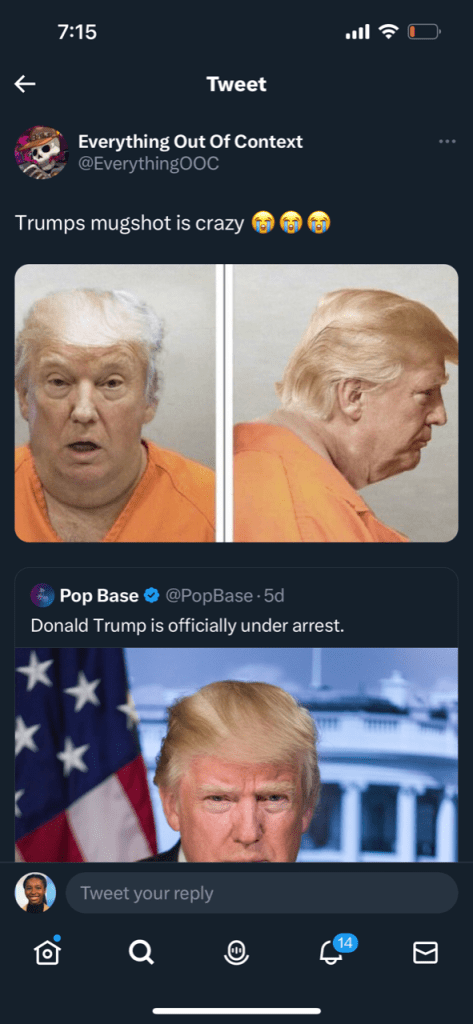
In the last few weeks, former US President Donald Trump was indicted on business fraud charges in New York. The entire internet was on fire as Trump was taken into court, and patiently waited for the “Donald Trump mugshot to drop”.
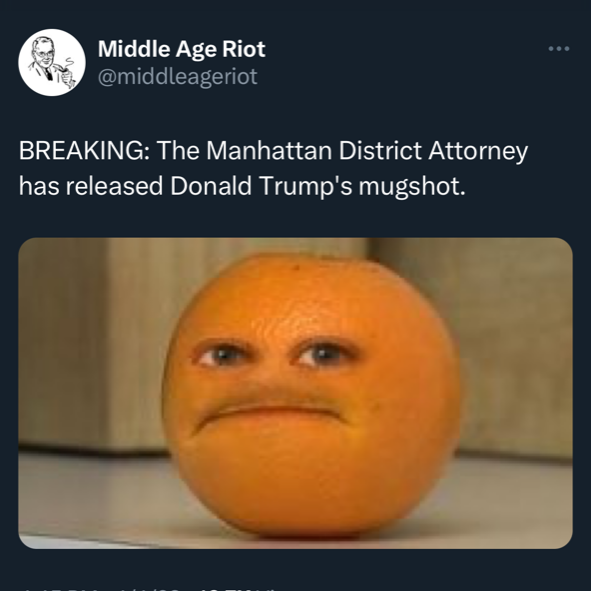
I waited for an actual mugshot to be released, but never came across a post by @scubaryan_ on Twitter. At first glance, I thought the photo was real, but I wanted to verify this photo and actively seek out information regarding the Trump headshot, whether there was one or not.
https://platform.twitter.com/widgets.jsDonald Trumps mugshot looks like he was crying before he turned himself in 😭 pic.twitter.com/Wrah6bPq6i
— ryan 🤿 (@scubaryan_) April 4, 2023
For the purposes of my analysis, I wanted to use the CRAAP test, which according to the chronicle.com, “instructs students to consider a source’s currency, relevance, authority, accuracy, and purpose.”
Why is it important to use tests like these? Oftentimes, we’re being hit with so much information our brains have a hard time processing all of it, a lesser form of information paralysis.
Sometimes, even when you are trying to verify a piece of information, you can be dumbfounded by the sheer amount of results you get. But following a test like CRAAP, can guide you through verifying that information with guidelines on how to use your power of the internet for your benefit.
And it has a fun acronym so it’s easy to remember!
C: Currency
The currency factor evaluates the timeliness and revision history of the information. However, upon further inspection of the post and with trying to find the timestamp of the post, Twitter offers a warning about the post.
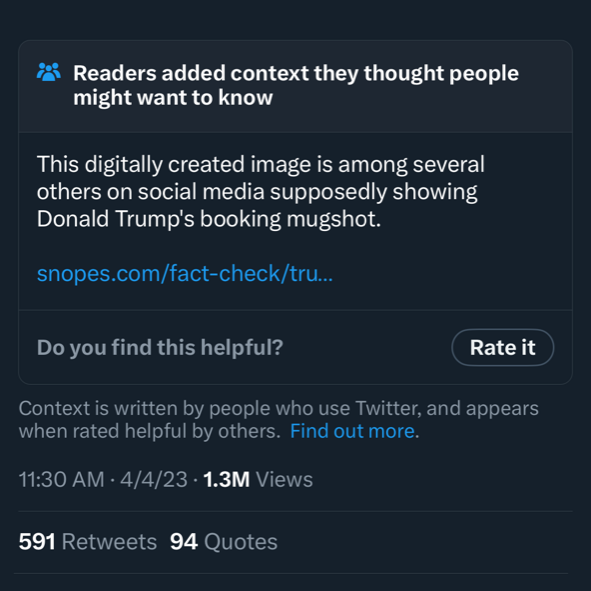
This is where I would normally stop an evaluation. If a social media platform is warning you about the post, you can probably conclude that it is not factual.
But, this doesn’t answer my original question
R: Relevancy
Relevance looks at where the information is answering the question you have, or who the intended audience is. This post answers the question, but after further analysis of the account, I’m not sure I’m the intended audience.
A: Authority
Who is the person posting this information, what are their credentials, and are they qualified to be speaking on this topic? Another thing to look at is what publishing information the post may have, which is hard to do on Twitter, but with a different post, such as this post from MSNBC, it’s relatively easy to find the publishing information.
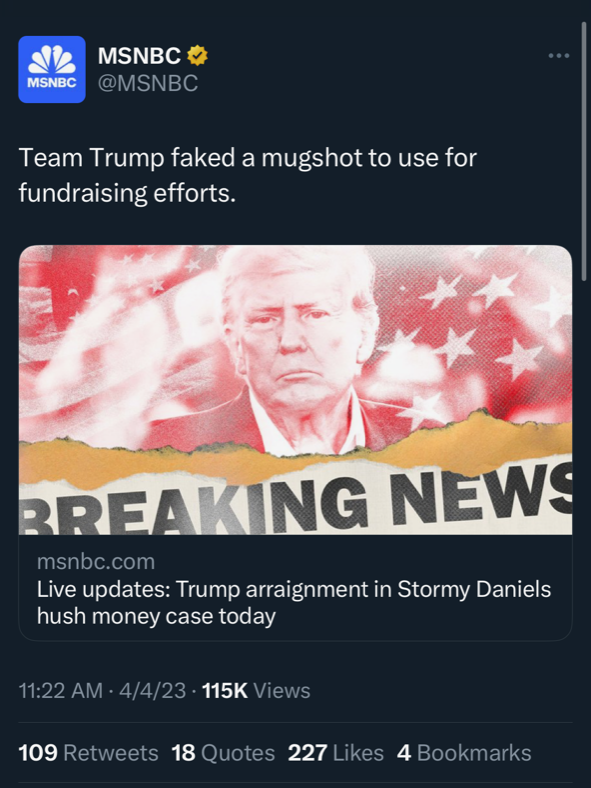
So, we can safely say the post is not accurate.
A: Accuracy
This part is pretty straightforward. Is this post accurate? According to the Twitter warning stamp, this post is not accurate and may contain inaccuracies or AI images.
In fact, that image was not the first or last photo I came across on my feed that was an AI image of Trump.
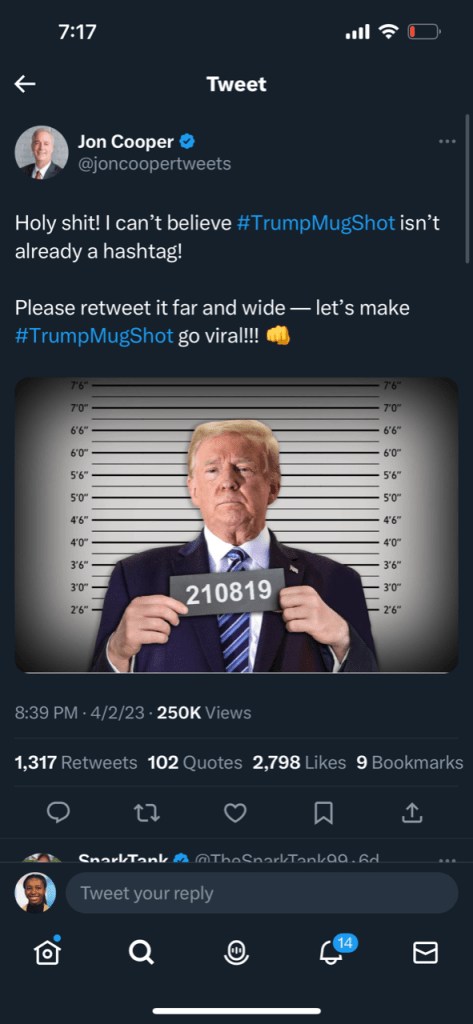
However, our analysis is not over. We still have arguably the most important step in the CRAAP test.
P: Purpose
Why was the post made? What are the author’s intentions of the post? Are those intentions clear? Could there be political, religious, ideological, institutional, and cultural biases at play in the creation of this information?
Looking at the original twitter post, I can see that the purposes were for funny, entertaining ones. But could there still be a Donald Trump mugshot out there and I wanted to find out the full story of the mugshot. I still had not concluded that the photo existed.
I decided to click on MSNBC, and apply CRAAP. Once I’ve worked through the test again, and arrive at purpose, I can come to my final my conclusion.
There was no Trump mugshot ever taken and therefore none that would be released. Trump, however, did use an AI image on t-shirts that he tried to sell to his followers and had sent out via email.
In this case, considering the purpose of why the original Twitter post was made, could it have been an illusory truth effect? This Washington Post article sums up the phenomena pretty well, “the more we see something repeated, the more likely we are to believe it to be true.”
It’s important that in the analysis of this post, and the question regarding whether a Trump mugshot existed or not existed that we consider the purpose of this type of information.
Could there be political ideologies at play in the reason for the posts? Especially, the amount of fake AI images that I saw being shared online, and more importantly by a public figure online. Could this be a part of tactics used by those who share misinformation?
I’m not sure, an expert will have to take a look at that, but it is vital that we ask ourselves these types of questions when evaluating information online.
 lydia curry
Leave a comment